I never thought I would have to consider the question:
Can I have a dog when I have a chronic disease?
I grew up believing that a girl and her dog could change the world. As an adult, I still believed that I was right. Dogs change our lives for the better.
But in 2012, when I was diagnosed with a type of Lupus, I didn’t realize the ways my chronic illness was about to change my life. I was not able to predictably attend social events; I had joint pain and fatigue and needed treatment for dramatic rises and falls in my platelet counts. I couldn’t do everything I used to do. But, as a life-long animal advocate, I also understood that responsible pet guardianship must consider the needs of our canine family members. So, when my mobility and health care needs changed, I considered whether I could still care for my dog.
Dogs Help Humans.
Observers have noticed for decades the positive effect animals can have on people’s well-being. Early pioneer Florence Nightingale noted the beneficial effect of animals on the ill, and psychiatry giant Sigmund Freud and child psychologist Boris Levinson noticed that their dogs, Jofi and Jingles, could facilitate psychotherapy. Florence Nightingale, an animal lover from childhood, was an early advocate of animal-assisted therapy. In Notes on Nursing, her classic treatise nursing, Nightingale outlined basic concepts of care of the sick and nursing practice and the benefit of animals in the care of the sick.
Jofi and Jingles, the dogs of psychotherapists Sigmund Freud and Boris Levinson, inspired change in psychotherapy. Freud and Levinson observed that their dogs could have a calming effect on their patients in the therapy room and could help humans identify and express feelings and fears. His dog Jingles inspired Levinson so much that the psychologist later dedicated his classic book, Pet-Oriented Child Psychotherapy, to Jingles. In 1969, Levinson’s book was the first to document the techniques of using animals in psychotherapy.
A Love Connection
But why do dogs help us?
Most of us who enjoy life with a companion dog have probably been tempted to claim that Rover or Fluffy is crazy about us. We can tell the way they look at us, even when we are not holding a double cheeseburger. There may be science to prove it.
In a 2015 study (1) published in the journal Science, researchers found that when dogs gaze into their special human’s eyes, and the human gazes back, an increased concentration of the hormone oxytocin is produced and exchanged between the human and dog. Oxytocin is essential in familial bonding and promotes feelings of attachment.The human-animal bond interaction is a unique interspecies form of attachment.
My dog Junior became my companion on my Lupus journey.
We adopted our Golden Retriever Junior as an 11-month-old vibrant pup, and he grew with me over the years into my constant 16-year-old senior canine companion. As I navigated my journey with chronic illness, Junior was my partner.
Then I watched my dog age .
He did it with grace. Junior knew what he could do at each stage of his life, and he did it with all the unabashed joy of a Golden Retriever. As our physical abilities waned at times, I realized that my dog and I both needed comfort, quiet times, conversation, and an occasional nap. As I struggled with my evolving chronic illness, I often needed an objective, non-judgmental listener who wouldn’t try to fix me. Junior was there. Dogs are great listeners.
Planning was key.
As our lives filled with changes in our capabilities, Junior and I learned to adjust our routines and support each other through the ups and downs. We modified our routines and equipment.
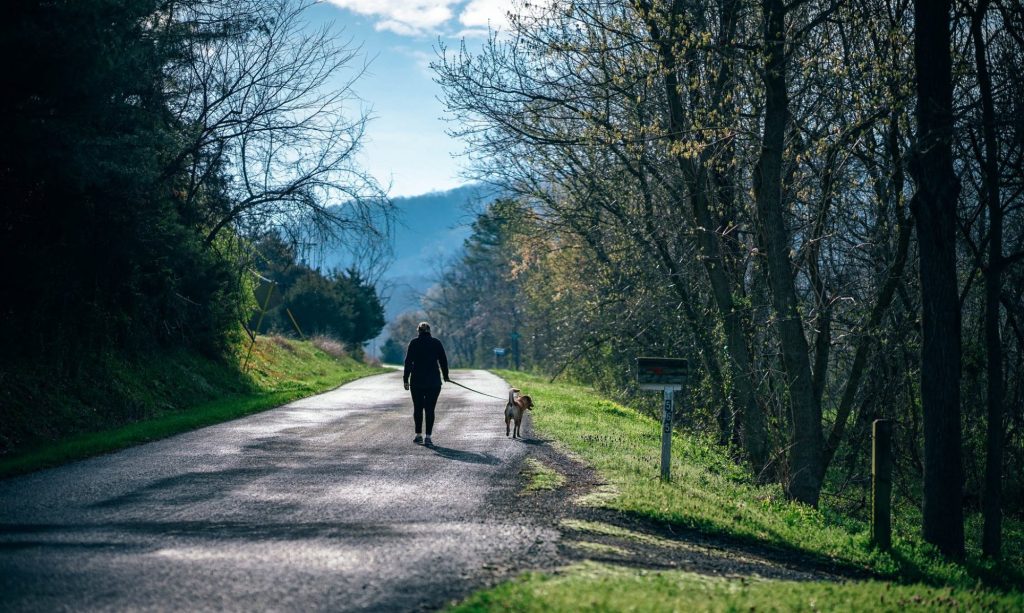
On our walks, I wore clothing that allowed easy access to my phone and ID in case of emergency. I didn’t listen to music during our walks to keep the focus on my canine partner and surroundings. We walked the same route with familiar people and safe environments. We adjusted our schedules and modified his gear (leashes, collars). I changed into sturdier shoes. We walked slower and not as far, ensuring our walks and times together were enjoyable and safe for both of us. As we both grew older, and I couldn’t move as well, we couldn’t take long walks. But my dog was still there for me.
We communicated and connected in a nonverbal way. I watched my dog’s body language and signals to understand his needs and paid attention to what my own body told me I needed. We planned each day’s activity accordingly. I found people and resources to assist me days when I needed assistance with walking, veterinary visits, or hefting a sizeable golden retriever into a vehicle. I made sure we both stayed current on our preventive health checks and wellness.
Having a dog by my side made all the difference.
Life with a chronic disease may present challenges, but with a dog as a companion, my journey was less lonely and filled with meaning. Our connection deepened, and I discovered the transformative power of the human-animal bond.
We found resilience along the way.
I know today that my chronic illness does not mean I cannot be a responsible pet guardian. Instead, having a dog makes for a special human-animal bond that provides healing and comfort to both partners.
Ours is a two-way relationship. I recognize I must be guardian of the health care of both members of our canine-human team. It’s a role I treasure. I have purpose.
And I still believe a girl and her dog can change theworld.
My dog changed mine.
Source:
Jill Schilp, Dogs in Health Care: Pioneering Animal-Human Partnerships(Jefferson, North Carolina, McFarland, 2019) 118-146.
Notes
(1)
Nagasawa,Miso, Shouhei Mitsui, Shiori En,Nobuyo Ohtani, Mitsuaki Ohta, Yasuo Sakuma, Tatsushi Onaka, KazutakaMogi, andTakefumi Kikusui. “Oxytocin-Gaze PositiveLoop and the Coevolution of Human- DogBonds.” Science 438, no. 6232 (2015): 333–36. doi:10.1126/science.1261022.
Copyright (c) 2024 Jill Lenk Schilp, All rights reserved

 Jill Schilp Writes